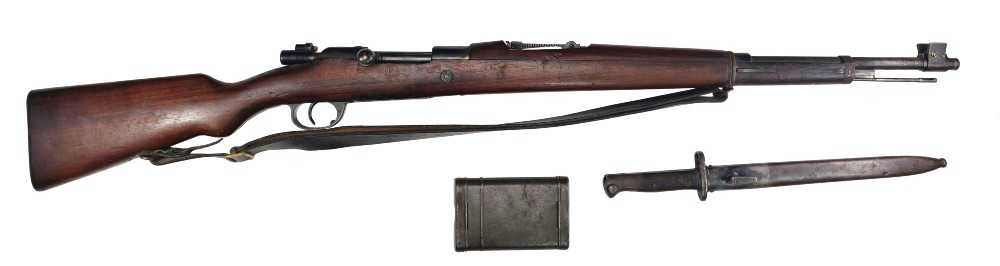
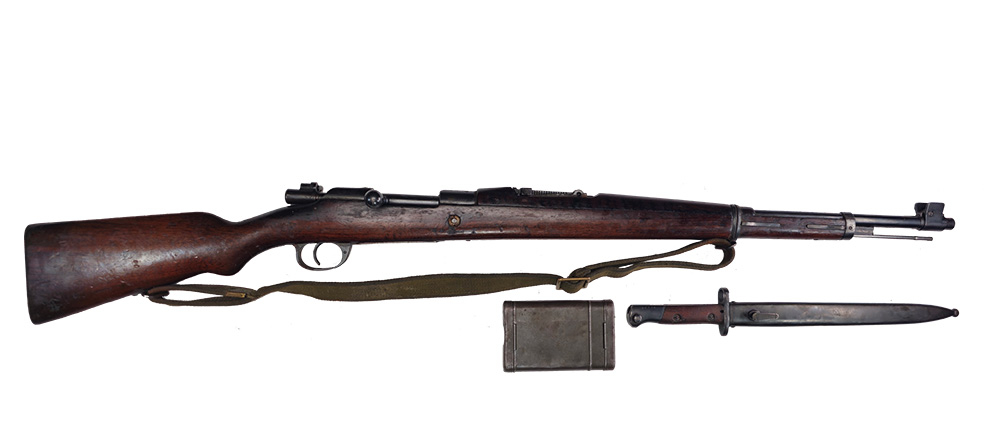
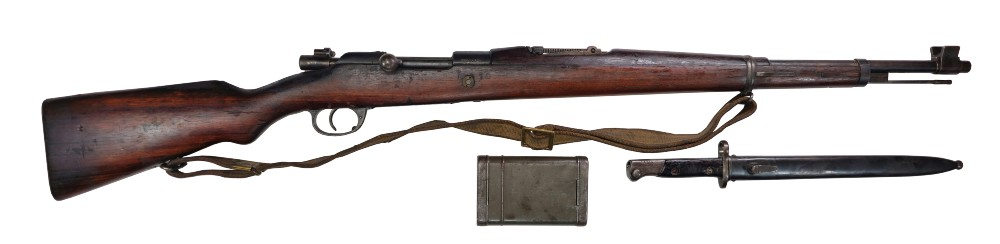
The video opens by introducing surplus Portuguese Mauser rifles converted to 8mm, specifically the DWM 1904-39 contract rifles now available with bayonets, slings, and cleaning kits in fair to good condition. The focus quickly shifts to the historical background that created these rifles. Portugal had been using a Kropatschek-type rifle, conceptually similar to the French Lebel and originally designed around black powder. By the early 1900s this system was outdated, prompting the search for a modern smokeless-powder service rifle. Portuguese officer José Alberto Vergueiro designed a new pattern, the Espingarda 6.5mm m/1904, built by DWM in Germany and chambered in 6.5x58mm. This rifle is emphasized as distinct from the more conventional DWM Model 1904 export Mauser. It features a split rear receiver bridge and a forward bolt handle that acts as a third locking lug, echoing designs like the Gewehr 88 and Mannlicher–Schönauer, and visually resembling later offshoot Mausers such as the Yugoslavian M48.
The discussion turns to how widely the Portuguese m/1904 pattern spread and how long it remained in use. Around 100,000 rifles were produced for Portugal from 1904 up to roughly 1960, making it a significant national service arm. DWM also filled foreign contracts using this pattern: approximately 5,000 rifles chambered in 7x57mm were supplied in 1906 to Brazil’s federal police, and about 20,000 rifles were sold to South Africa in 1915 to help cover shortages of Enfield rifles during wartime. Even after official retirement by the Portuguese military around 1960, these rifles continued to appear in African conflicts, much like other older weapons that resurface in modern wars. This long and scattered service history sets the stage for understanding why so many variants and conditions exist today, and why collectors encounter rifles with diverse markings, calibers, and field wear.
Attention shifts to the major 1939 modernization that created the 8mm Mauser Portuguese rifles featured for sale. Portugal shortened the original long 29-inch barrels to about 24 inches and rechambered the rifles from 6.5x58mm to 8x57 Mauser, redesignating them as Espingarda 8mm m/1904-39. The goal was to approximate the handling and ballistics of the German K98k, which Portugal was adopting as a modern standard. Receivers often retained their original 6.5mm and 1904 markings, with only some rifles individually overstamped by armorers, making careful caliber verification essential. A distinctive front sight protector was added, designed so the entire front sight assembly can be removed via a screw to allow windage adjustment, likely done by military armorers. The rear sight base was ground down and recalibrated so the traditional sliding rear sight, marked from 200 to 2,000 meters, would provide correct elevation for the new 8x57 cartridge.
The video highlights the surplus packages being offered: each DWM 1904-39 Portuguese Contract 8mm Mauser typically comes with a sling, a two-compartment cleaning kit containing a bore snake and brushes, and a G98-type bayonet. Some rifles feature fully matching serial numbers, while others are non-matching, and in certain cases the bayonet number matches the receiver even when other parts do not. A German K98k is brought in for direct comparison, showing how the K98k’s rearward bolt handle and solid rear receiver bridge are better suited for scope mounting, while overall length and handling are similar to the converted Portuguese rifles. The 1904-39 retains its older Mannlicher-influenced bolt system but feels familiar in the shoulder. Typical surplus issues such as minor stock cracks and wear are discussed, with a strong recommendation that any older rifle be inspected by a competent gunsmith before firing, especially when dealing with caliber conversions and mixed-condition parts.
In closing, the presenter frames these Portuguese Mausers as essential pieces for Mauser enthusiasts who want to explore lesser-known evolutionary branches. Mauser rifles in general are praised as excellent firearms, and the 1904/39 stands out as an interesting offshoot that did not lead to further mainstream development. Portugal ultimately standardized on the K98k pattern as its modern service rifle, but earlier long-configuration 1904 rifles likely saw use in World War I, while Portuguese troops in later conflicts often carried older Kropatschek rifles or British-issued weapons for logistical reasons. Portugal remained officially neutral in World War II, so the 1904/39 conversions probably did not see combat in that conflict. The video suggests treating this rifle as part of a broader series on historical “dead ends” and unusual variants, inviting ideas for future episodes that examine other obscure designs, side branches, and transitional models within the wider Mauser family.





















 Loading...